
New treatment alternatives for mild appendicitis
An inflamed appendix is, in many cases, a mild or uncomplicated condition that can be treated with antibiotics rather than a surgical operation. It appears that it might even be possible to heal mild appendicitis without antibiotics. Our research team is investigating whether antibiotic therapy and hospital care could be entirely avoided in the treatment of mild or uncomplicated appendicitis.Published: 4.12.2025
Text: Jussi Haijanen
Editing: Viestintätoimisto Jokiranta Oy
Image: Shutterstock
Over the past century, the treatment of acute appendicitis has involved the surgical removal of the appendix (appendectomy), which is still among the most common emergency surgeries worldwide. Acute appendicitis occurs either as a mild, uncomplicated inflammation of the appendix or a more severe, complicated appendicitis.
Of these two disease forms, only complicated appendicitis will typically result in a rupture and, thus, always requires surgical treatment. The majority of cases, however, are of the mild type. Prior to considering the treatment options and initiating treatment, an abdominal CT scan is routinely performed for the differentiation of the two forms of appendicitis.
Treatment at hospital is not necessarily needed
For over 15 years, Turku University Hospital (TYKS) has led the national APPAC (APPendicitis Acuta) study group. The APPAC group has focused on the conservative treatment of uncomplicated acute appendicitis. The first three randomised multi-centre trials (APPAC, APPAC II and APPAC III) have shown that, in most cases, it is possible to treat uncomplicated acute appendicitis safely and effectively with either antibiotics or symptomatic care, without any surgery.
The results from the APPAC trials, combined with other research data, suggest that a mild appendicitis could even be treated in an outpatient setting, without intravenous medication that requires hospitalisation. The currently ongoing APPAC IV is a national, double-blind, multi-centre trial comparing the efficacy of oral antibiotics versus an oral placebo in the treatment of uncomplicated acute appendicitis. Also, unnecessary hospitalisation would be avoided if patients could be discharged directly from the emergency room.
In Finland, four university hospitals (Turku, Oulu, Tampere and Kuopio) and five central hospitals (Lahti, Pori, Jyväskylä, Seinäjoki and Mikkeli) are involved in the APPAC IV trial. A total of 498 randomly selected patients will be invited to take part in the trial, of whom more than one half have already been recruited.
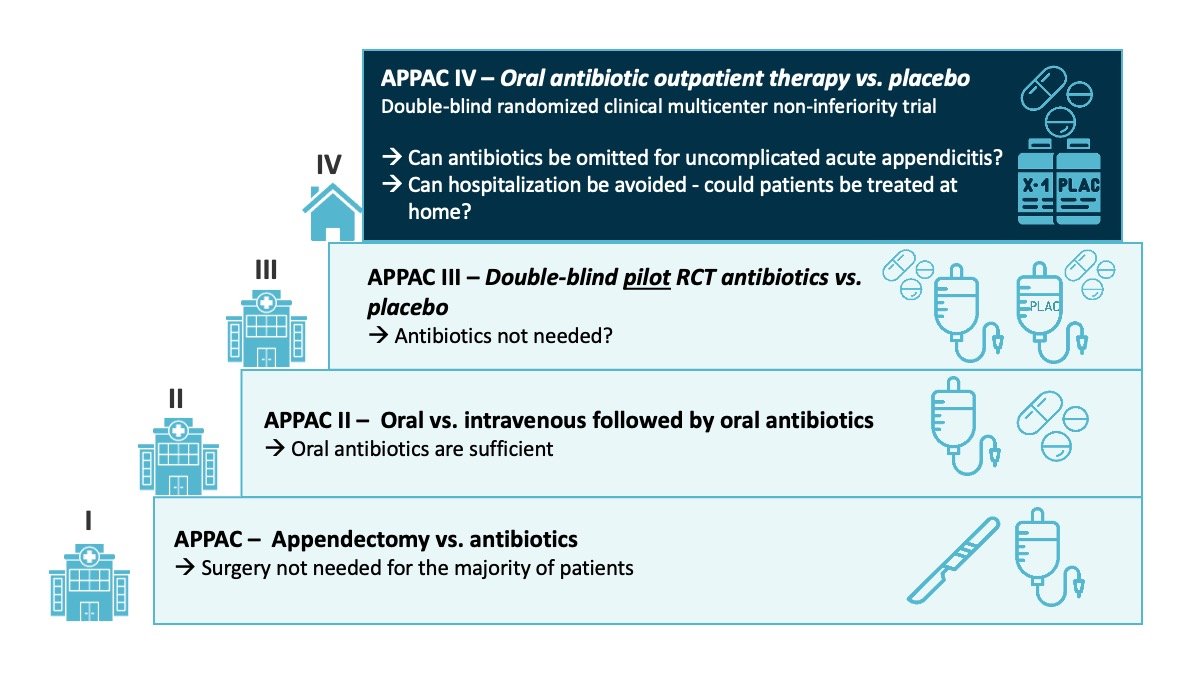
Research questions and key results of the Finnish APPAC multi-centre trials.
The new treatment practice would reduce the costs
An article reporting on the cost-related data from the earlier APPAC II study has recently been approved for publication. According to the data, the costs of antibiotic therapy are significantly lower in comparison to surgical treatment. Moreover, antibiotic therapy saves resources in terms of surgical facilities and wards.
In Finland, nearly 8,000 appendectomies are performed annually (THL 2019–2023). Our estimation is that some 30–50 percent of them, or up to 2,400–4,000 surgeries, could be avoided. Avoiding unnecessary surgeries would help to optimise the use of healthcare resources.
Surgery is no longer the only possible treatment for appendicitis.
In June 2025, the Clinic of Gastroenterological Surgery at TYKS decided to change the treatment practices in response to the latest research evidence. Thus, regardless of whether they take part in the currently ongoing APPAC IV trial or not, patients with a mild acute appendicitis will primarily be treated with oral antibiotics at home instead of by surgery at hospital.
If hospitalisation could be avoided for patients with acute appendicitis, the declined number of days in hospital care would result in major cost savings. Also, surgical facilities and wards could then be more optimally used for the treatment of various other conditions. Finally, if it is found that mild appendicitis can heal even without antibiotic therapy, the use of antibiotics could be reduced, which would contribute to the prevention of the antibiotic resistance crisis.

Jussi Haijanen, MD, PhD, is working as Specialist in Gastroenterological Surgery at Turku University Hospital (TYKS). In addition to his clinical work, he serves as a postdoctoral researcher in the APPAC study group and a supervisor for four doctoral candidates, who are working on their dissertations based on the APPAC studies.