
Does biodiverse nature protect against tick-borne diseases?
Tick populations appear to grow exponentially, and ticks have spread to almost every corner of Finland. Results from research are supported by the numerous tick observations received by the University of Turku from citizens. Now, scientists are exploring how the biodiversity of forests affects the risks caused by ticks to people and pets.Published: 1.10.2026
Text: Jani Sormunen
Editing: Viestintätoimisto Jokiranta Oy
Images: Henna Rouhainen, Shutterstock
As a result of ticks becoming increasingly common, the occurrence of tick-borne diseases is also on the rise. In terms of the most well-known tick-borne diseases, namely borreliosis and tick-borne encephalitis (TBE), the number of cases has clearly grown due to increasing tick contacts.
Unfortunately, there is no imminent solution to the problem in sight, since climate warming favours both ticks and their host species. It is not possible, at least with the currently available means, to eliminate ticks from nature, but it might be possible to address the issue on a smaller scale. However, the effective targeting of control measures is challenging because our knowledge of ticks is still insufficient.
It all comes down to vertebrate animals
Ticks are dependent on vertebrate animals, which serve as the source of their blood meals. To find a blood meal host, the tick species living in Finland climb on vegetation to ambush and attach to a passing animal. These ticks do not much wander around, but they may occasionally seek cover, for example, under fallen leaves in order to keep themselves moist.
Once the tick has enjoyed its blood meal and is engorged with blood, it drops off to the ground, develops to the next life stage and continues living roughly in the same spot. When hatching from its egg, a tick does not usually carry any pathogens, but rather acquires pathogens when feeding on the blood of an infected host animal. Thus, there is a strong correlation between the type and frequency of pathogens carried by the ticks and the host species of the specific area. A key question is, therefore, in what ways the host species in the area affect the disease risk caused by ticks.
The host species matter
It is not insignificant for ticks and tick-borne pathogens which host animal species live in their habitat. Host animals may, for example, move in different ways, which has an influence on the probability that ticks will encounter them and drop off into a favourable environment after feeding on their blood. The host species also plays a role in terms of the quality of tick blood meals: Borrelia bacteria do not survive in the blood of the deer, and accordingly, ticks that feed on their blood do not become pathogen carriers. On the other hand, a large portion of ticks feeding on voles, shrews and squirrels may become infected.
The network of interactions between the diverse host animal characteristics and the life-cycles of pathogens and ticks is associated with a disease-ecological theory known as the dilution effect. As far as ticks and tick-borne pathogens are concerned, the dilution effect predicts that an increasing variety of host species in an area will reduce the number of pathogen-carrying ticks therein. The reduction is explained by the higher probability and frequency of encounters with such host species that lack the potential for transmitting pathogens or maintaining tick populations.
A general understanding is that the biological diversity of a forest – the variety of species, amount of dead wood, age structure – also has an impact on the diversity of animal, plant and microbe species living there. It can be concluded that, in areas with a high biodiversity, it is probable to have a larger variety of host animals, whereby, as predicted by the dilution effect, the risk of tick-borne diseases will be lower.
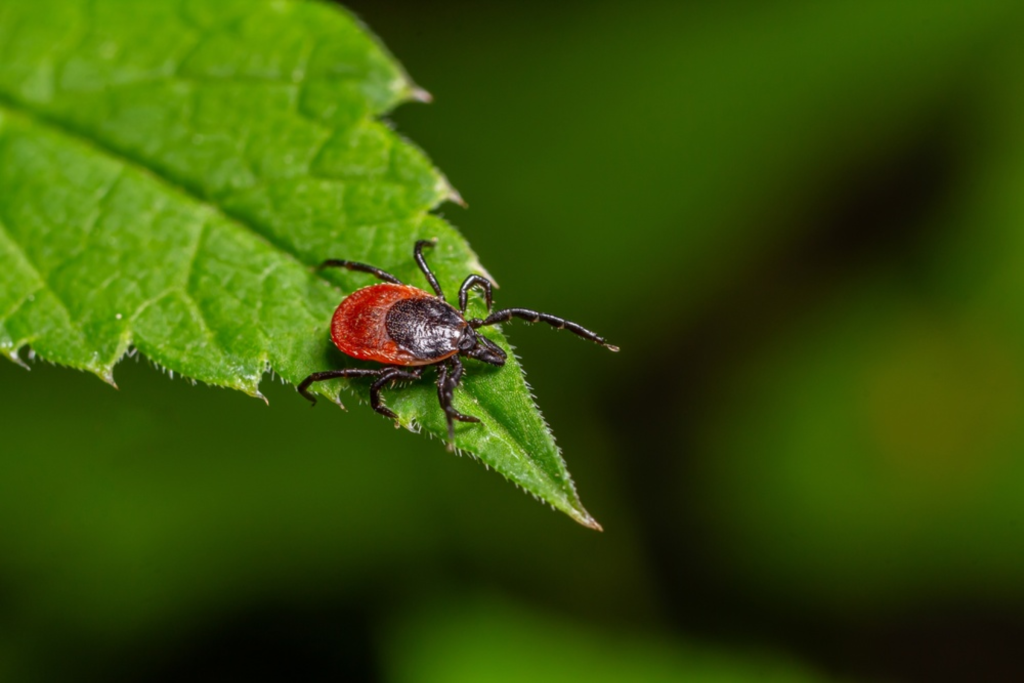
What is the effect of forest biodiversity on the risk of tick-borne diseases?
With funding from the Sakari Alhopuro Foundation, our research project aims at exploring the ways in which the biodiversity of a forest affects the risk of tick-borne diseases for people and pets. We study tick populations and pathogens carried by them in protected coniferous and deciduous forest areas rich in biodiversity as well as select forest areas near them that are subject to industrial forestry. Primarily, our research seeks to determine whether a dilution effect can be observed and there are less ticks or tick-borne pathogens in forest areas with a high biodiversity.
In addition to the abundances of tick populations and prevalence of tick-borne pathogens, we will examine which host animals are maintaining ticks in different areas. By means of blood meal analyses, we can identify on which animals the ticks have fed in their previous life stage, because identifiable residuals of the most recent blood meal remain in their guts. Thus, by examining young ticks, known as nymphs, we can conclude what animal they have fed on as larvae and, consequently, where the pathogens carried by them originate.
The information from the blood meal analysis enables us to assess the risks caused by the ticks, while also telling us which host species they have fed on, and whether there may be dilution effects occurring. Moreover, we are examining whether forest areas with a high biodiversity also have more diversified environmental microbial communities and structure, and in what ways they relate to the tick microbiome and pathogens carried by them.
Hopefully, our research will give answers to questions such as what type of risks different forest areas form to people and if it is possible to tackle the threat caused by ticks by, for example, supporting natural biodiversity. Researched knowledge about the degree and type of risks in different areas or areas in different use will help us assess possible prevention measures and the need to provide information about the risks.

Jani Sormunen, PhD, Adjunct Professor (Medical Entomology), is currently working as Academy Research Fellow in the Department of Biology, University of Turku. Sormunen has headed the University of Turku Tick Project since 2019, and his research covers a broad range of topics related to ticks and tick-borne pathogens. Recently, he has focused on assessing the risks to humans by using the extensive tick observation data from Punkkilive, the nationwide citizen-science website.