
Climate change accelerates Baltic Sea eutrophication
The blue-green algae season has grown longer in recent years, and this year, algal blooms were observed even in October–November. This change is the result of the eutrophication of the sea, which is accelerated by climate change. Ilppo Vuorinen is calling for rapid protection measures and extensive cooperation to improve the state of the sea.Published: 16.12.2025
Text: Leena Hulsi / Viestintätoimisto Jokiranta Oy
Images: Terri Vahtera and Jaakko Ruola
We have managed to improve the state of the Baltic Sea here and there, but overall, the situation remains bad. The most worrying situation is in the Archipelago Sea, which is still on the Baltic Marine Environment Protection Commission’s (HELCOM) Hot Spot list.
There is plenty of researched information about the causes of the poor state of the Baltic Sea, and anyone can see the need for protection with their own eyes. Blue-green algae are in the headlines every summer, so the problems are known and there is a lot of talk about improving the state of the sea. According to Professor Emeritus Ilppo Vuorinen, however, there has been little action.
“It is high time for us to pick up the pace, because climate change will only bring more challenges to the state of the sea. There are solutions to rectify the situation, and they need to be adopted quickly”, Vuorinen stresses.
Lost landscapes
Vuorinen has been interested in the impacts of climate change on the state of the sea since the 1980s – back when the issue was played down even in academic circles.
The Professor says he spent his childhood summers in Ruissalo, near the northern edge of the Airisto Inlet, and remembers a sea with very clear water, bladderwrack and flounder.
“My mother worked as a journalist for a newspaper, so our family had the opportunity to spend summers at Villa Nordkap, near Kukkarokivi, which was owned by the Turku Journalists’ Association. In the early-1960s, the sea was still clean, with few reeds and plenty of bladderwrack. When I visited the region again in the 1990s, the situation was completely different: the sea was murky, reeds had displaced the bladderwrack and the fish were gone – the landscape of my childhood had disappeared.”
Changes in the state of the sea could be seen elsewhere in the Archipelago as well. When Vuorinen attended the field courses at Seili research station for the first time as a young ecology student in the early-1970s, it was possible see the seafloor in Nauvo harbour, even 3–4 metres deep.
“By the mid-1980s, the state of the sea was significantly worse. I attended a research trip on the Aranda for the first time in 1985 and I still vividly remember older researchers’ remarks when we entered the Gulf of Bothnia: ‘Right – so it’s here now’”, Vuorinen recalls.
‘It’ referred to blue-green algae, which has since become a permanent problem in the Archipelago Sea in particular. Vuorinen thought that something had happened since the mid-1970s that was harmful to the sea and began to investigate the potential reasons for this change.
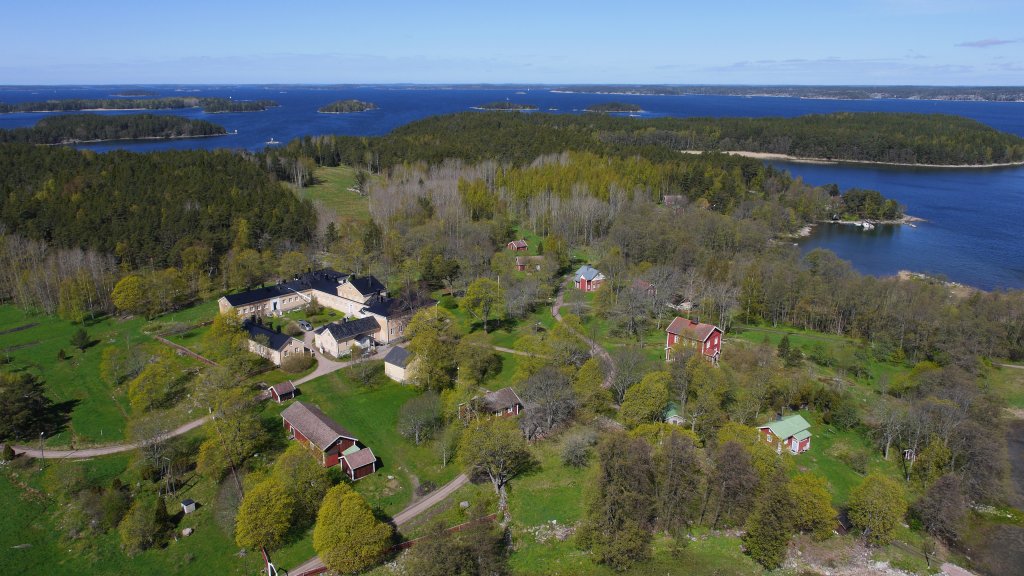
Ilppo Vuorinen served for many years as director of the University of Turku’s Archipelago Research Institute, located on the island of Seili. The institute is known, among other things, for its unique long-term data series. Photo: Jaakko Ruola.
Nutrient loads are increasing
Vuorinen says that climate change began to be mentioned in the 1980s, but even the scientific world did not understand much about it then.
“My statements about the connection between climate change and the state of the sea were mostly met with amusement. However, in the early-1990s, I managed to gather evidence on it with Jari Hänninen, the current Director of the Archipelago Research Institute. Today, the connection is crystal clear to everyone”, Vuorinen states.
Vuorinen and Hänninen drafted mathematical models demonstrating that the amount of westerly winds above the British Isles is connected to the North Atlantic Oscillation, or atmospheric pressure index. The latter, in turn, affects how much freshwater enters the Baltic Sea.
“Based on our calculations, we drew a salinity graph, which proved to be consistent with the results of marine sampling. The decrease in salinity affects Baltic Sea ecosystems in a variety of ways”, Vuorinen says.
Many things are now intertwined in a manner that spells trouble for the Baltic Sea. The biggest loading factor for the sea is agricultural nutrient runoff, i.e. phosphorus and nitrogen, the amounts of which are estimated to increase as climate change progresses.
“In the future, rains will become more frequent and rainfall will increase, washing even more nutrients to the sea. The consequences of climate change are difficult to predict, but they will certainly not improve the situation. This is why the protection of the Baltic Sea and Archipelago Sea must be taken seriously now”, Vuorinen says.
Putting research information into practical use
The state of the Baltic Sea and the Archipelago Sea, in particular, is nearing critical, so restoration efforts must begin without delay. For a long time, researchers have worried about the state of the marine environment and the loss of biodiversity, but now decision-makers and companies are taking notice of the poor condition of the sea as well.
“The significance of the Archipelago Sea to the wellbeing and vitality of our region is understood, and I believe that there is also a will to save the sea. Researchers have plenty of information about the root causes of the problems and the means to solve them. Now this research information must be put into practice”, Vuorinen stresses.
The Baltic Sea Archipelagos Symposium, organised by the Sakari Alhopuro Foundation, aims to bring researchers, decision-makers as well as company and media representatives together next April to promote concrete measures to improve the state of the sea.
“We are hoping that higher education students from different disciplines will also participate, as natural scientists will need the support of engineers, economists and legal scholars. Representatives from agriculture and the fertiliser industry are also needed for this to succeed. We should not be pointing fingers but seeking sustainable solutions together.”
Vuorinen hopes that every citizen takes part in saving the sea.
“I don’t think anyone wants their swim to be prevented by toxic algal blooms or to be forced to sail in a porridge of blue-green algae. We should think about how our own everyday choices affect climate change and, thus, the future of the sea”, Vuorinen says.
Event website: Baltic Sea Archipelagos Symposium
The Blue Book of Archipelago Sea of Finland – solutions to improve the state of the Archipelago Sea
The Blue Book of Archipelago Sea of Finland, compiled by Kalervo Väänänen, Rector Emeritus of the University of Turku, is a work that anyone interested in improving the state of the Archipelago Sea should read. Together with dozens of experts, Väänänen has drafted a concrete action plan to remove the Archipelago Sea from the Baltic Marine Environment Protection Commission’s (HELCOM) Hot Spot list.
The Baltic Sea region Hot Spot programme originally listed 162 industrial, municipal and agricultural sites with emission sources that were heavily polluting the sea. Most of the sites were cleaned by 2020, but the Archipelago Sea remains on the list. The reason is that the agricultural load on the Archipelago Sea has not been reduced sufficiently. The Blue Book details solutions to rectify the situation.
Väänänen’s three-phase action plan
Measure 1
Reduce nutrient runoff
- Optimise fertiliser use
- Prevent land erosionPay attention to farmland porosity
- Utilise gypsum and structural lime treatments
- Set protection zones optimally
Measure 2
Remove nutrients from the Archipelago Sea and its drainage area ecosystem
- Recover biomass from land and sea and prepare recycled fertilisers, biogas and biochar from it
- Ensure that the plants making recycled fertiliser are big enough to facilitate R&D and the manufacture of marketable products
Measure 3
Increase wild fish harvesting and sustainable fish farming
- Draft a national strategy to increase the harvesting and use of wild fish
- Emphasise R&D and the manufacture of new products in the strategy, and invest in the domestic and international marketing of the products