
What is the role of microbes in the Arctic Ocean sediments?
Global warming has a strong impact on the coastal areas of the Arctic Ocean. As a result of permafrost thaw, the melting of sea ice cover and increased river flow rates, coastal soil is being washed into the ocean. Now, the researchers are investigating the role of microbes in the biogeochemical processes occurring in the sediment on the ocean floor.Published: 6.8.2026
Text: Kirsi Keskitalo
Editing: Viestintätoimisto Jokiranta Oy
Images: Kirsi Keskitalo
Arctic temperatures are rising up to four times faster than the global average. Climate warming results in the melting of both sea ice and permafrost, that is, soil that has been frozen for at least two successive years.
Enormous amounts of organic matter have accumulated in the soil that has been frozen for thousands of years in permafrost regions. It is estimated that these carbon storages contain twice as much carbon as there is currently in the atmosphere. Along with the decomposition of this organic matter, greenhouse gases are released into the atmosphere, which will further intensify the warming of climate.
The coasts of the Arctic Ocean in Siberia are vulnerable in terms of permafrost thaw, as the permafrost in these areas has largely a very high content of ice. As a result of the thawing of this ice-rich permafrost, the coastline may collapse abruptly, thus accelerating the of soil into the ocean.
Coastline erosion is intensified by the melting of sea ice. Without the sea ice cover, the coasts are exposed to higher waves and storms washing away coastal soil. In some places, the coastline is already receding by more than ten metres per year. Moreover, the flow rates of arctic rivers are anticipated to increase, which will accelerate the discharge of soil matter into the ocean. Once in the ocean, the organic matter will either settle as sediment on the ocean floor, or degrade and release greenhouse gases.
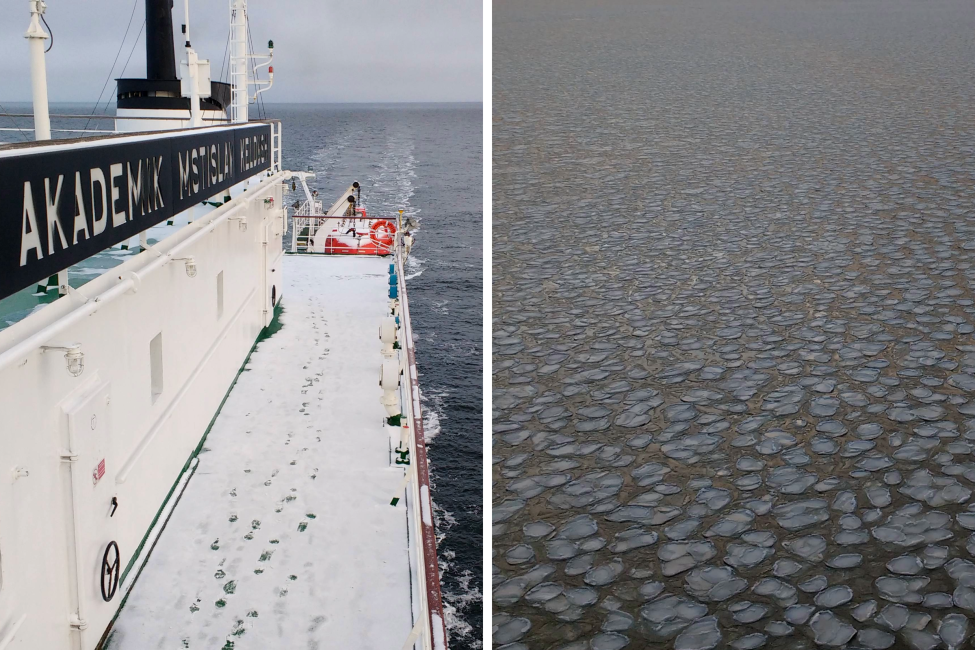
Microbes help to understand process occurring on the ocean floor
The purpose of our project is to investigate, by means of molecular techniques, what happens to organic matter on the ocean floor. For our research, we use sediment samples from the Siberian continental shelf within the Kara, Laptev and East Siberian Sea areas.
The sediments on the ocean floor are important for carbon storage, but their capacity to store carbon is anticipated to weaken as a result of global warming, partly because of the increase of soil eroding into the ocean. Also, microbes in the ocean floor may decompose organic matter, thus releasing greenhouse gases.
In previous research, microbial communities have been identified in different parts of the Arctic Ocean by means of metagenomic analysis methods, in other words, by studying the genes of microbial communities found in the sediments. However, very little research on microbial metabolism has been conducted in this region.
Using metabolomic methods, our aim is to identify the end-products of microbial metabolism, which will help to understand the biochemical processes that have taken place in the sediments. Additionally, we will map the composition and origin of the sediments so as to gain a better understanding of the microbial habitats.
The ocean floor is transforming along with climate change
The bottom of the Arctic Ocean is changing along with climate change. Coastal erosion and stronger river flows will increase the volume of organic soil matter on the ocean floor. Moreover, oceanic primary production is anticipated to grow, which will affect the amount and composition of organic on the seabed.
By integrating metagenomic and metabolomic analyses with geochemical methods, we will be able to explore the functioning of microbes in various environments and investigate how the increased amount of organic matter and its composition may affect the microbial functions and degradation of organic matter. Our work will contribute in characterising the composition of the seabed sediments in the constantly changing Arctic Ocean and the functioning of microbes in these environments, while also assessing the potential influence of these processes on global warming.
The sediment samples we use for our research were collected in 2020 as part of a Swedish-Russian research project focusing on the study of the impacts of climate change on the Siberian continental shelf.
Kirsi Keskitalo, PhD in Earth sciences, is currently working as Research Fellow in Northumbria University, United Kingdom. Her work focuses on carbon cycle and greenhouse gas emissions in Arctic permafrost areas, in both streaming waters and the Arctic Ocean. For research, she has applied biogeochemical analysis methods.
Sources:
- Arrigo, K.R. and van Dijken, G.L.: Continued increases in Arctic Ocean primary production. Prog Oceanogr, 136,60-70, doi.org/10.1016/j.pocean.2015.05.002, 2015.
- Fritz, M., Vonk, J. E. et al.: Collapsing Arctic coastlines. Nat. Clim. Chang. 7:6–7 doi:10.1038/nclimate3188, 2017.
- Hugelius G, Strauss J, et al.: Estimated stocks of circumpolar permafrost carbon with quantified uncertainty ranges and identified data gaps. Biogeosciences. 11:6573–6593, doi:10.5194/bg-11-6573-2014, 2014.
- Jeon, J., Park, Y. et al.: Microbial profiling of the East Siberian Sea sediments using 16S rRNA gene and metagenome sequencing. Sci Data, 11:1350. doi.org/10.1038/s41597-024-04177-0, 2024.
- Oziel, L., Gürses, Ö. et al.: Climate change and terrigenous inputs decrease the efficiency of the future Arctic Ocean’s biological carbon pump. Nat. Clim. Chang. 15:171–179, doi.org/10.1038/s41558-024-02233-6, 2025.
- Rantanen, M., Karpechko A.Y. et al. The Arctic has warmed nearly four times faster than the globe since 1979. Communications Earth & Environment 3, no. 168: 1–10. https://doi.org/10.1038/s43247-022-00498-3, 2022.
- Walker, A.M., Leigh, M.B. et al.: Patterns in Benthic Microbial Community Structure Across Environmental Gradients in the Beaufort Sea Shelf and Slope. Front. Microbiol. 12:581124.doi:10.3389/fmicb.2021.581124, 2021.