
Simulating future disease risks in computational laboratories
Environmental and ecological changes are increasing the risk of emerging infectious diseases globally. Understanding the complex biological systems and related interactions that influence the spreading of diseases is a central challenge for modern infectious disease research. In her research project, D.Sc. (Tech.) Miracle Amadi is developing computational models for the assessment of risks related to disease transmission.Published: 18.6.2026
Text: Miracle Amadi
Editing: Viestintätoimisto Jokiranta Oy
Image: Shutterstock, Miracle Amadi
Emerging infectious diseases are among the greatest scientific and public health challenges of our time. More than 70 percent of emerging human infectious diseases originate from animals. Climate change, habitat fragmentation, biodiversity loss and increasing human interaction with wildlife are reshaping how diseases spread across populations and ecosystems.
Rather than being governed by a single factor, disease transmission is influenced by inherently complex biological systems and related interactions. Understanding these interactions between hosts, pathogens, movement, immunity, behaviour, genetics and environment is a central challenge for modern infectious disease research.
My research focuses on developing computational and statistical methods for studying these complex biological systems. I work at the intersection of mathematics, epidemiology and ecology, using computational models to better understand how diseases spread and how reliable our predictions about them truly are.
During my doctoral research at LUT University, I developed agent-based models for the study of malaria transmission. The model incorporated household structure, mosquito behaviour and intervention measures, such as bed nets. Unlike traditional mathematical models that describe populations as averages, agent-based models simulate the behaviour and interactions of individual agents, allowing us to study disease dynamics in much greater detail.
Biological systems are unpredictable
One way to think about these models is as “computational laboratories”. Traditional laboratory experiments help scientists study biological mechanisms under controlled conditions, whereas computational simulations allow researchers to explore how diseases may behave under different ecological and social scenarios that would be impossible, unethical or impractical to test in the real world.
However, there is a major challenge involved in simulations. Biological systems are noisy and unpredictable. Running the same simulation twice can produce different outcomes because of randomness in movement, infection, behaviour and environmental interactions. This raises an important scientific question: how much can we trust the predictions of these models?
A major focus of my current research is, therefore, uncertainty quantification, which aims to measure the reliability of computational predictions. Instead of treating model outputs as exact answers, uncertainty-aware methods attempt to determine how much confidence we can place in the results and which conclusions remain robust despite noisy data.
Making uncertainty visible, measurable and useful
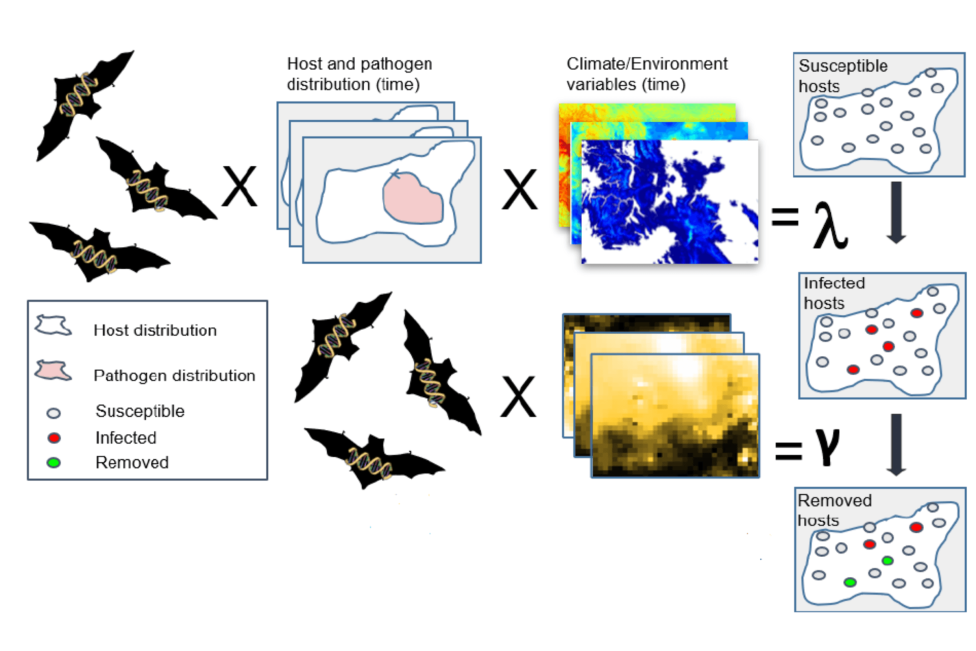
With support from the Sakari Alhopuro Foundation, I am extending my work to ecological and eco-evolutionary disease systems using the spatially explicit agent-based modelling framework, CDMetaPOP, developed by Erin Landguth and colleagues at the University of Montana.
My aim is to explore how environmental change, movement across landscapes and evolutionary processes may jointly influence wildlife disease dynamics and future infectious disease risks. As an example system, the work explores White-Nose Syndrome (WNS) in North American bats, a fungal disease that has devastated bat populations across large regions. Beyond its ecological consequences, wildlife disease research also provides broader insight into how environmental disruption can reshape future disease risks across ecosystems.
More broadly, the computational approaches developed in this work may also help address other epidemiological and environmental challenges, such as the increasing spread of tick-borne diseases associated with expanding white-tailed deer populations in Finland.
My earlier work has also shown how statistical modelling can contribute to real public-health issues. In collaboration with the Finnish Institute for Health and Welfare (THL), I analysed long-term measles antibody data in order to understand how vaccine-induced protection changes over time and what this may mean for herd immunity. Although this is a different disease system, the underlying scientific question is closely related: how can we use imperfect data to make reliable conclusions about complex biological systems?
The aim is not to predict the future with certainty. Biological systems are too complex for that. The aim is to make uncertainty visible, measurable and useful. If we can understand where predictions are reliable, where they are fragile and what assumptions they depend on, computational models can become more responsible tools to support science, public health and environmental decision-making.

Miracle Amadi, D.Sc. (Tech), is a Postdoctoral Researcher in Computational Engineering at LUT University, Lappeenranta. In 2022, she earned her PhD from the same university, and her doctoral thesis, which dealt with hybrid modelling methods for epidemiological studies, received the 2022 Finnish Inverse Problems Prize. Her research focuses on uncertainty quantification, Bayesian inference and computational modelling of infectious disease and ecological systems.