
Behind the art: Kalle Hamm
The artwork series created by Kalle Hamm will include a book and a participatory work, which is a kind of a volvelle timeline of the different stages of the Seili meadows since the birth of the Earth. These will allow visitors to Seili to learn about the life of the archipelagic meadows.Published: 19.2.2026
Text: Kalle Hamm
Editing: Viestintätoimisto Jokiranta Oy
How did you become an artist?
I became interested in different forms of artistic expression at a young age. I wrote poetry, played the flute, acted in a youth theatre group and drew non-stop. After upper secondary school, it was obvious that art school was the next step for me. I started by applying to visual arts institutes and got in on my first attempt. After a few twists and turns, I graduated as a sculptor from the Lahti Institute of Fine Arts in 1994, and then obtained a Master’s degree in Arts from the University of Art and Design Helsinki (UIAH) in 2002. Recently, I have added sounds, writing and some other childhood interests to my palette of expression.
What is your relationship with nature?
I grew up in a small rural community surrounded by nature. This allowed me to see both its beauty and its cruelty – the cycle of life and our role in it. I’m interested in wild plants, which means that most of my nature experiences revolve around spring, summer and autumn. All kinds of things happen in the plant kingdom, even in winter, but I work most actively during the growing season.
Tell us a bit about your project that the Foundation is funding?
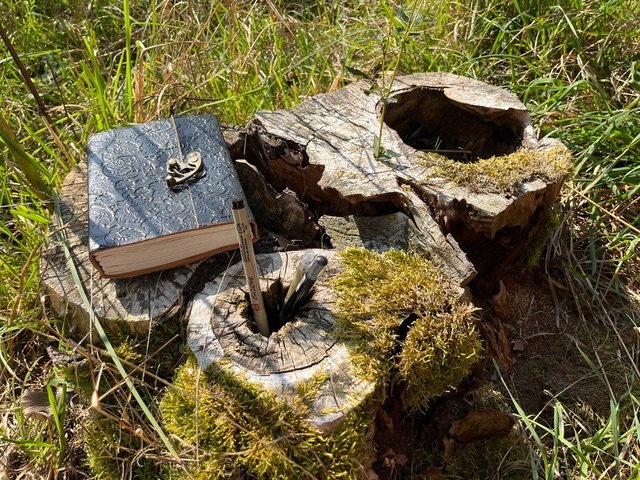
Biologist Jasmin Inkinen, sound artist Olli Aarni and myself have set up four observation plots in the meadows on the Seili Island, and will monitor them for two years. The material we gather will be used for an art series which I will complete by the end of 2026. The series will include a book and a participatory work, which is a kind of a volvelle timeline of the different stages of the Seili meadows since the birth of the Earth. These will allow visitors to Seili to learn about the life of the archipelagic meadows.
What does art mean to you?
Art sees and shows things from new perspectives. It also serves as an excellent tool for self-reflection, allowing us to contemplate our own relationship with different things.
For me, art is a tool for both verbal and non-verbal thinking.
What has been the greatest art experience of your life?
There have been many, but in these turbulent and uncertain times, I often find myself visiting the website showcasing Ian Hamilton Finlay’s Little Sparta garden. His art beautifully combines visual and literary expression, and immersing myself in it has given me much food for thought. His poem Ovidian Flowers is a fine example.
Ovidian Flowers
Veronica became Temptress
Hibiscus became Spry
Arabis became Saucy
Periwinkle became Restless
Calendula became Ready
Begonia became Impulse
Larkspur became Fury
Heartsease became Courage
Candytuft became Tenacity
Ian Hamilton Finlay (1998)
The names of the plants in the poem refer to the Second World War and the British Flower-class corvettes, which were originally named after flowers (e.g. Veronica, Begonia, Hibiscus). Some of them were transferred to the US Navy, where they were renamed after human characteristics (e.g. Temptress, Impulse, Spry).
The world needs thought-provoking art. This blog series goes behind the art, featuring artists and works supported by the Sakari Alhopuro Foundation. In 2025, the art grants were awarded to artists who address aspects of climate change, biodiversity loss or the state of Finnish nature in their work.